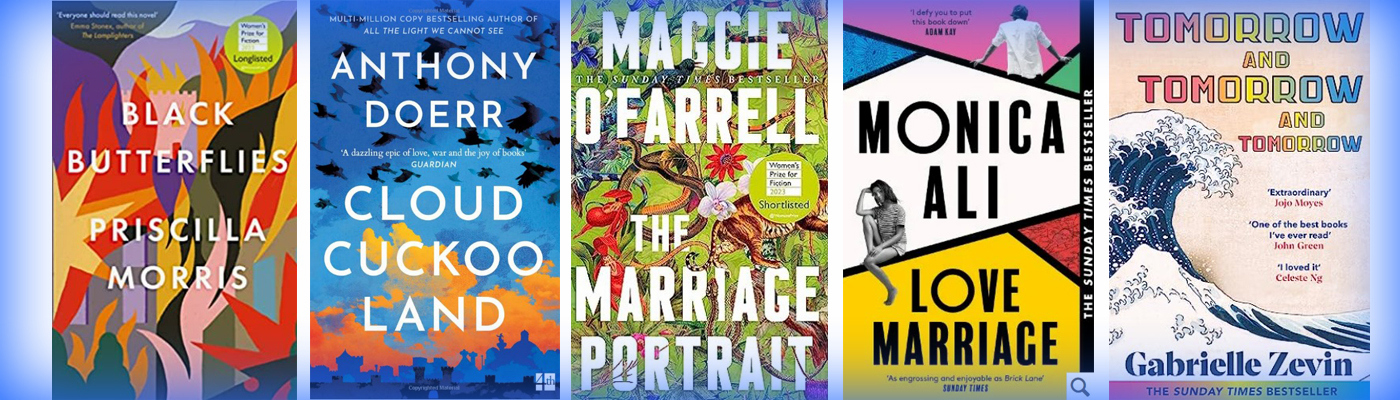
As we approach the summer break, I hope those who follow this blog, and/or who may connect with me on Twitter, Facebook or LinkedIn, might have more time to read for pleasure. Many of my contacts work in the field of education, and I know from my own experience that relaxing on holiday, at home or further afield, with a good book, can be a great way to unwind – to recharge the batteries, rest, refresh and re-energise.
I read all the time – and fiction is my preferred material. I have fairly eclectic tastes, and often choose books recommended by friends. So I hope recommending a few titles that I have enjoyed recently might be useful to others.
‘Black Butterflies’, Priscilla Morris
I chose this book, written by a young woman of Yugoslav/English heritage, because I saw that it was a first novel which had been shortlisted for the Women’s Prize for Fiction, which is no mean feat – Morris appearing alongside authors like Barbara Kingsolver and Maggie O’Farrell. I remember – though I’m not sure I ever fully understood – the Siege of Sarajevo in 1992. Morris describes the experience of Zora, an artist and teacher caught up in the conflict, fighting to survive, and finding friendship and love in the process. It is a sobering but powerful story which immerses us in a time and place and plots the transformation, and disintegration, of an originally beautiful, cultured and tolerant city.
‘Cloud Cuckoo Land’, Anthony Doerr
I had read, and loved, Anthony Doerr’s ‘All the Light We Cannot See’, and so chose to read ‘Cloud Cuckoo Land’, which I also very much enjoyed – though it is very different from the earlier novel. It is a complex, multi-layered narrative set in different places and different times, between which it constantly moves, which reminded me of David Mitchell’s most ambitious fiction (‘Cloud Atlas’, for example). It explores the subjects of literature and civilisation, destruction, resilience and love. I found the characters compelling and the plot intriguing, as Doerr weaves together the different narratives and reveals the connections between them.
‘The Marriage Portrait’, Maggie O’Farrell
I have taught the Browning poem ‘My Last Duchess’ several times during my career and, if you don’t know it, I would recommend you read this dramatic monologue before embarking on the novel, which tells the story of Lucrezia, the duchess of the poem, from her childhood, into her marriage to the Duke of Ferrara, the creation of the portrait, and her subsequent fate. This was a book I simply wanted to keep reading. I loved the 16th century setting, O’Farrell’s descriptive flair and creation of atmosphere, the exploration of the relationship between men and women, with a dark undercurrent of power and threat.
This novel tells the story of Yasmin, a trainee doctor, as she navigates her demanding family, her worklife and her engagement to Joe, a fellow medic who has a complex relationship with his high-profile, outspoken activist mother. I found Ali’s capacity to create a range of complicated, believable and sympathetic characters impressive – I realised that I cared about what happened to just about all of them. The potential for conflict between cultures, and generations, is fully explored, and the book is comedic and touching by turns. The examination of modern identity and the issues of race, class, gender, sexuality and belief kept me interested throughout, and the final revelation of truth from the past was unexpected and powerful.
‘Tomorrow and Tomorrow and Tomorrow’, Gabrielle Zevin
The story here takes us into the world of the design and development of computer games. It is a novel about friendship, about collaboration, and the world of business. The central characters, Mazer and Sadie, meet initially as children in a hospital where they bond over Super Mario Bros. Years later, they meet again by chance, now students at Harvard and MIT, and they pick up and develop their alliance as they work together to create and then market innovative games. The world of gaming is seen as offering the possibility of escape from pain, from disability and even ultimately from a sense of mortality, as it allows multiple tomorrows – lose a life, but restart the game to try again.
I hope that you may find at least one of these to your taste, and that you enjoy the reading experience. If you haven’t already, perhaps also have a look at my three short novels, available as an e-book and in paperback: The Dresser #OneWord The Button Box eBook : Berry, Jill: Amazon.co.uk: Kindle Store. I look forward to discussing ‘#OneWord’ with Kiran Satti at the WomenEd Book Club on Twitter on Sunday 6th August. And for information, I am currently almost half way through my latest story, which focusses on the experiences of a family of four during the pandemic from March 2020 to the summer of 2021. The working title is ‘How can you..?’
Happy reading!

 jillberry102